Character & Citizenship Education
Explore how our Character and Citizenship Education programmes develop students into caring, responsible and engaged members of society.
Philosophy and Approach
With CCE as the cornerstone of development, Westwoodians learn values through perspective taking, moral reasoning, reflection and skills practice, role modelling by teachers, and positive reinforcement during structured and non-structured lesson time and teachable moments.
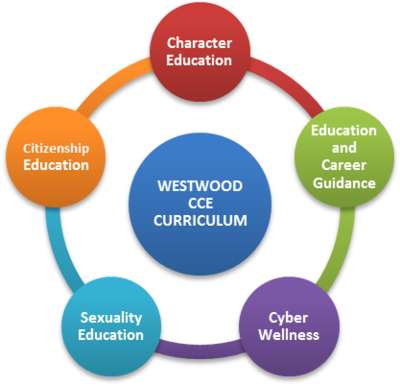
Values are both taught and caught! The school puts in place a structured CCE curriculum that encompasses Citizenship Education, Character Education and 3 Guidance modules - Education and Career Guidance, Sexuality Education and Cyber Wellness. There is explicit teaching with knowledge and skills encapsulated in the CCE learning outcomes, and yet at the same time, values are caught when students see values lived out in different learning experiences. The CCE curriculum takes a thematic approach in its curriculum design and programme implementation with the desired outcome of instilling in each Westwoodian strong core values and character. In line with learning for life, the curriculum covers essential knowledge, skills and competencies that are critical to students achieving the level milestones and 4 desired learning and behavioural outcomes identified by Westwood.
An integral part of the Westwood CCE curriculum is the teaching of Social and Emotional competencies which is essential for appropriate display and demonstration of values by students. As a whole school approach, every Westwood staff member is a CCE teacher, role modelling in leading and upholding the core values. Rich learning experiences are carefully designed, integrated intentionally and seamlessly into all aspects of student programmes through different platforms in the co-curriculum including the National Education commemorative days, Co-Curricular Activities, Values in Action and Student Leadership for the learning and application of knowledge, skills and values.
Character Education
Objectives
Instil values in Westwoodians and equip them with essential lifeskills that would enable to them to achieve personal well-being and effectiveness, develop and demonstrate social-emotional strength, and build and maintain positive relationships with others
Programmes
Character Education lessons are delivered via the Home@Westwood platform which is time-tabled in the formal curriculum, and runs on a weekly basis for all levels and streams. During the one-hour lesson, both Form and Co-Form Teachers will co-facilitate and engage students in discussions and perspective sharing. Learning activities are carefully designed to incorporate the use of current affairs, where possible. Teachers use pedagogies such as Circle Time to engage students in critical thinking, co-constructing ideas, perspective sharing and reflecting on their learning. The school also engages external vendors to put up performances or conduct assembly talks that are aligned to character education.
External vendors are also engaged to run personal effectiveness workshops to supplement lesson packages prepared by the curriculum team. Such workshops are organised as a follow up to the school-wide annual student needs survey where class/level needs and expectations are identified and intervention measures are taken to help close the gaps.
Citizenship Education
Equip Westwoodians with knowledge and skills, and build commitment in students towards active and informed citizenship so that they will
reflect on and respond to community, national and global issues,
develop socio-cultural sensitivity,
promote social cohesion and harmony, and
develop a sense of identity, pride and rootedness to Singapore.
Programmes
Citizenship Education lessons are delivered via the In-Touch platform which runs on a weekly basis for all levels and streams. Students could either have classroom lessons where they are engaged in interesting discussions and debates on the latest current issues or attend assembly talks and/or performances. Students are drawn into meaningful discussions that are facilitated by Form and Co-Form Teachers. The enriched learning process enables students to develop greater awareness of development within the country and beyond, and gain insights into how issues beyond the shores will have an impact on Singapore and vice versa.
Skills related to citizenship competencies are internalised and reinforced through activities such as:
Educational learning journeys
Commemoration of Total Defence Day, Racial Harmony Day
Participating in events on International Friendship Day and National Day
Organising Values in Action projects/events
Many of these activities are planned and organised by the National Education Ambassadors whose leadership skills are put into real practice, and in the course of project/event planning, their capacity and spirit of resilience are built up.
Sexuality Education
MOE Sexuality Education in Schools
1. Sexuality Education (SEd) in schools aims to enable students to understand the physiological, social and emotional changes they experience as they mature, develop healthy and rewarding relationships with others, including those with members of the opposite sex, and make wise, informed and responsible decisions on sexuality matters. SEd is premised on the importance of the family as the basic unit of society. This means encouraging healthy, heterosexual marriages and stable nuclear family units with extended family support. The teaching and learning of SEd is based on respect for the values and beliefs of the different ethnic and religious communities in Singapore on sexuality issues.
2. The Goals of Sexuality Education are to:
(a) Support students in managing their physiological, social and emotional changes as they grow up and develop safe and healthy relationships.
(b) Guide students to make wise, informed and responsible decisions on sexuality matters.
(c) Help students develop a moral compass and respect for themselves and others by having positive mainstream values and attitudes about sexuality that are premised on the family as the basic unit of society.
3. The Key Messages of Sexuality Education are:
(a) Love and respect yourself as you love and respect others;
(b) Build positive relationships based on love and respect (which are the foundation for strong families);
(c) Make responsible decisions for yourself, your family and society; and
(d) Abstinence before marriage is the best protection against STIs/HIV and unintended pregnancies. Casual sex can harm and hurt you and your loved ones.
You may click here (opens in new tab) for more information on MOE Sexuality Education.
Overview of Westwood Secondary School's Sexuality Education Programme for 2025
4. Sexuality Education is delivered in a holistic manner through the school curriculum. The content for Sexuality Education is grouped into five main themes: Human Development, Interpersonal Relationships, Sexual Health, Sexual Behaviour, and, Culture, Society and Law. You may click here for more information on the scope of Sexuality Education in the school curriculum.
5. The subjects that incorporate topics on sexuality include:
a. Science
b. Character and Citizenship Education (CCE)
Sexuality Education Lessons:
6. The values and attitudes of our youth towards sexuality are increasingly shaped by their peers, exposure to the media, popular culture and the internet. Adolescence is a complex stage in life as the adolescent attempts to find his or her own identity and often struggles with new social relationships. The period of middle adolescence (generally from 15 – 17 years old) can be a turbulent period for adolescents. The gap between physical and emotional/cognitive maturity may result in a tendency to act on impulse, experiment with various activities (including sexual activities), sometimes without understanding the unpleasant consequences that may arise from such experimentation. The need for peer acceptance can be overwhelmingly strong and hinder one’s ability to act responsibly. Given the pressures faced by the middle adolescent from within themselves and from peers, it is important to build a strong sense of self-worth, personal conviction and an understanding of the possible consequences of sexual behaviour.
7. Through the Sexuality Education lessons, secondary students will have the opportunity to develop a positive self-esteem, develop their character, and expand their understanding and repertoire of skills to deal with various issues related to sexuality, which are of prime concern at this age.
Click here (opens in new tab) to view the Sexuality Education Programme in Westwood Secondary School.
eTeens Programme
8. eTeens is a programme developed by Health Promotion Board, in collaboration with the Ministry of Education, to provide Secondary 3 students with accurate information on STIs, HIV and protection from a health perspective. With the formation of the Communicable Diseases Agency (CDA) on 1 April 2025, the programme would now be managed by CDA’s Training and Education Division instead of HPB. eTeens is conducted in two segments – a mass talk segment and a classroom-based programme. The desired outcome of the eTeens programme is that students are empowered to make wise, informed and sensible decisions to protect themselves from sexually transmitted infectious diseases.
9. Students are taught skills such as decision-making, assertiveness and negotiation to say “no” to sex and negative peer pressure. They also learn that the impact of STIs/HIV extends beyond themselves and involves their family, and the importance of responsible decision-making and seeking help. Abstinence and upholding family values are the key messages.
Topics in Sexuality Education
Topics/Lessons | Programme Learning Objectives | Term Period |
|---|---|---|
Mass Talk delivered through a pre-recorded video | Raise awareness and provide knowledge on: a) Sexually transmitted infectious diseases (STIs and HIV): what it is, how it spreads, how to prevent infection mainly through ABC (abstinence, being faithful, correct, and consistent condom use), consequences and impact b) Skills for respecting boundaries (e.g. decision-making, assertiveness, negotiation to say ‘no’ to peer pressure) c) Managing relationships and risky situations in a healthy way, including avenues for help-seeking. | Term 4 Week 1 |
Classroom-based Lesson | Learn to negotiate their way out of a risky situation by applying skills of assertiveness and responsible decision-making | Term 4 Week 2 |
Information for Parents
10. Parents may opt their children out of the Sexuality Education lessons, eTeens and/or supplementary sexuality education programmes by MOE-approved external providers.
11. Parents who wish to opt their children out of the Sexuality Education lessons need to complete an opt-out form. This form will be communicated to parents at the start of the year and is also available here (opens in new tab) The completed form is to be submitted by 31/1/2026.
12. Parents who wish to opt their children out of the eTeens programme need to complete an opt-out form. This form will be communicated to parents at the start of the year and is also available here (opens in new tab). The completed form is to be submitted by 31/1/2026.
13. Parents can contact the school at 6792 9737 or email at westwood_ss@moe.edu.sg (opens in new tab) for discussion or to seek clarification about the school’s Sexuality Education programme.
Education & Career Guidance
Objectives
Deepen students’ understanding of self and enhance capacity to relate schooling to different education and career pathways. By going through four years of ECG activities and programmes, Westwoodians get to:
explore the career world,
understand the relevant courses of study, and
develop awareness of their skills, interests and values
Programmes
Westwood designs its ECG programme using the ECG ASPIRE Framework. ECG programmes and activities are progressive in nature and they come in four levels:
Level 1: Attitudes and behaviors related to academic achievement
Level 2: Relationships between educational achievement and career planning
Level 3: Career planning skills
Level 4: Decision-making skills in career and education planning
Explicit ECG lessons are delivered via the Home@Westwood platform where both Form and Co-Form Teachers will co-facilitate and engage students in exploration, discussion and action planning. The school conducts learning journeys and visits to Open Houses so that students can find out more about the different courses of study offered by various institutions of higher learning. The school also organises the Westwood Careers Day and Work Experience Programme to allow students to find out more about the industry that they are interested in directly from industry professionals/practitioners.
To introduce students to possible courses of study in post-secondary education institutions and expose them to possible career paths, the school organises Elective Modules (for Normal Technical and Normal Academic streams) such as Science of Motor Vehicles and Tourism, and Advanced Elective Modules (for Express stream) like Application Science in Forensics and Marketing in Action.
The school also leverages the use of an online portal - ecareers.sg (opens in new tab) that facilitates education and career development among students. This portal aims to help students discover their identity through awareness, exploration and planning.
Cyber Wellness
Objectives
Enable Westwoodians to develop good understanding of the norms of appropriate, respectful and responsible behaviour with regard to the use of technology, and equip them with knowledge, skills, values and attitudes so that they are able to:
embrace ICT yet maintain a balanced lifestyle between the physical and cyber world,
harness the power of ICT for positive purposes, and
protect themselves and other internet users in the cyber world.
Programmes
The school implements its cyber wellness education through a spiral progression approach to reinforce learning and meet the developmental needs of students. It conducts a 4-hour cyber wellness module via the Home@Westwood platform for each level every year. Conducted by Form and Co-Form Teachers, these lessons are delivered using various pedagogies such as games, debates and Circle Time. The school collaborates with Family Matters@School to conduct workshops for parents to raise awareness of different social media platforms and challenging issues that impact youths in the digital age. In addition, the school also engages external vendors to put up skit performances and connect with external professional agencies to conduct assembly talks as part of the school-based CCE programme.
The school has put in place the provision of intervention and support to students who might be encountering cyber wellness-related issues and also work with parents of students to help their children in this area.